
Discover our solutions for fully fire-safe 🔥 roofs
5-3-2026
A structured view of rooftop PV fire safety
In rooftop PV fire safety, many solutions exist but the overall approach often lacks structure. Arc fault detection, spacing, monitoring and roof materials each address different parts of the fire risk. We explain how we analyse photovoltaic fire risk through a structured seven-layer model and why structure is essential.
In the market for rooftop photovoltaic panels, we see a growing number of fire mitigation solutions:
Arc fault detection.
Rapid shutdown systems.
Connector upgrades.
Monitoring platforms.
Spacing guidelines.
Fire-resistant membranes.
Additional cover boards.
The number of solutions continues to expand.
What we observed, however, is that rooftop PV fire risk is rarely analysed within a consistent structure. Solutions are often discussed individually, without clearly defining which part of the fire risk they influence.
That makes comparison difficult.
And it makes residual risk unclear.
For that reason, we approach rooftop PV fire safety through a structured seven-layer model.
Not as a checklist.
Not as a product ranking.
But as a way to understand escalation behaviour on flat roofs with photovoltaic panels.
Our seven-layer structure
Each layer influences a different part of rooftop PV fire risk.
Layer 1 – Structural roof assembly
Deck, insulation, membrane and overall combustibility of the flat roof build-up. This layer determines how the roof behaves once exposed to sustained heat.
Layer 2 – Electrical design strategy
Voltage architecture, string layout and component compatibility. This layer influences long-term ignition probability.
Layer 3 – Array configuration and fire dynamics
Module spacing, density and ventilation gaps. Photovoltaic panels modify heat feedback and flame behaviour on the roof surface.
Layer 4 – Installation quality
Cable routing, connector handling and mechanical detailing. Many PV fires originate in workmanship deficiencies rather than design errors.
Layer 5 – Inspection and maintenance
Thermography, monitoring and periodic inspection. Degradation over time must be managed to limit fire risk in photovoltaic systems.
Layer 6 – Active electrical protection
Arc fault detection and rapid shutdown systems. These measures aim to interrupt abnormal electrical behaviour early.
Layer 7 – Operational containment
Accessibility, zoning and firefighting interface. This layer influences containment once escalation occurs.
How the layers work together
Not all layers serve the same purpose.
Layers 2, 4, 5 and 6 primarily reduce ignition probability.
Layers 1 and 3 determine fire spread behaviour.
Layer 7 limits the consequences once escalation occurs.
As a building owner, insurer or risk engineer, you are therefore not looking for one solution.
You are looking for a combination of measures that reduces rooftop PV fire risk on your specific flat roof to a level that is manageable and insurable.
Each layer closes a different gap along the escalation path.
The question is not which product is best.
The question is whether the combined layers sufficiently reduce both ignition probability and fire spread on the roof.
Layer 1 in focus – why a non-combustible roof is foundational
Within this model, Layer 1 is structurally decisive.
When photovoltaic panels are installed on a flat roof, heat can accumulate beneath the array. If combustible insulation is present in the roof assembly, it can become part of the fire load.
In that case, the roof does not simply support the fire.
It feeds it.
Combustible insulation can enable:
- Lateral fire spread beneath the membrane
- Vertical flame penetration into deeper roof layers
- Increased fire intensity
- Escalation from a local PV fault to roof-wide fire spread
In structural terms, the roof assembly becomes an active energy contributor.
If the roof assembly is functionally non-combustible, the situation changes fundamentally.
There is no meaningful fuel within the roof build-up.
Subsurface fire spread becomes highly unlikely.
The probability of large-scale escalation is significantly reduced.
The photovoltaic panels themselves may still be damaged.
Glass fragmentation may still occur.
But the chance that a local failure develops into major flat roof fire spread becomes much smaller because the roof does not provide additional energy.
Once the roof assembly is structurally non-combustible, the focus of the other layers shifts toward:
- Protecting the photovoltaic panels
- Limiting damage to rooftop equipment
- Managing environmental exposure
- Ensuring firefighter safety
They no longer compensate for a combustible structural base.
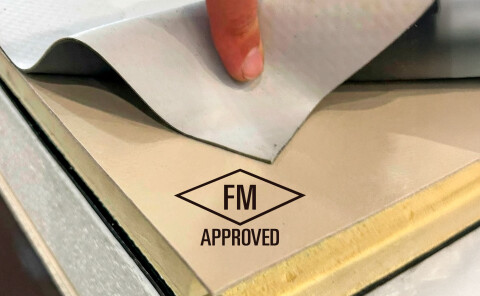
Within this seven-layer framework, AllShield BarrierSheet operates at Layer 1.
As a lightweight, non-combustible cover board integrated into the roof assembly, it reduces the ability of heat and flame to involve underlying combustible insulation. Its role is not ignition prevention. Its role is escalation control at the structural level.
That distinction is fundamental.
Continuing refinement
We are convinced that rooftop PV fire safety must be analysed through this layered perspective.
At the same time, we continue refining how these seven layers can be translated into a consistent assessment framework for designers, building owners and insurers.
The model defines how we think.
Its practical application continues to evolve.
Our roof fire 🔥 protection solutions
Fire safety is the goal, insurability is the result
Flat roofs – especially those with solar panels – face an increasing fire risk. Even the best fire-retardant membranes offer limited protection against flying sparks or thermal ignition beneath PV panels. That’s why AllShield developed two non-combustible fire protection systems, each tailored to a specific application.
Do you have any questions for us?
We're here for you!
