
Discover our solutions for fully fire-safe 🔥 roofs
1-9-2025
FM 4484: a new global fire-safety standard for solar roofs
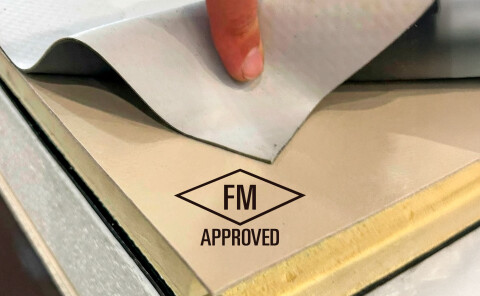
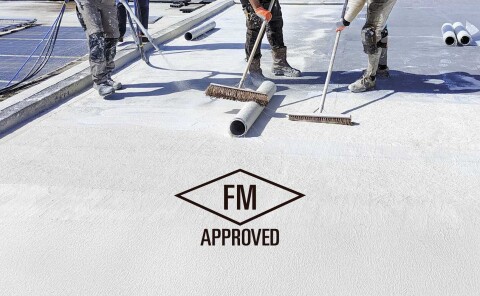
FM 4484 is the new FM Approvals fire-safety standard for roofs with solar panels. It defines how retrofit coatings are tested under realistic PV-fire conditions — setting a global benchmark for insurable solar roofs. AllShield Blue is FM 4484 Approved.
FM 4484, Approval Standard for Retrofit Coatings for Roof-Mounted Photovoltaic Module Systems is the latest and most advanced fire-safety standard developed by FM Approvals: FM 4484
It addresses a challenge that traditional roof tests never covered: the unique fire behaviour of existing roofs retrofitted with solar panels.
We are proud to announce that our AllShield Blue coating has been the first coating to be Approved for the FM 4484 standard!
Why FM 4484 was introduced
In recent years, insurers and fire experts have seen a sharp increase in rooftop fires involving PV systems.
Most incidents start with an electrical failure - a hotspot, a connector fault or an arc - but quickly escalate because the space beneath PV modules traps heat, creating a chimney effect.
Conventional roof standards such as FM 4470 and FM 4478 assess the performance of new roof assemblies, that can be insured by following RoofNAV.
To close that gap for the fire behavior of existing, retrofitted roofs,, FM Approvals released FM 4484 in 2025. The standard defines how to test retrofit coatings or protective layers applied over existing roofing materials when rigid PV modules are installed above them.
FM 4484 Test Method
FM 4484 recreates realistic PV fire conditions using a 360 kW burner operating at 760 °C (±10 °C), with a wind speed of 5.4 m/s, applied for 10 minutes at a roof slope of 5/12 inch.
It evaluates:
- How flames propagate beneath photovoltaic modules.
- Whether a retrofit layer prevents ignition or flame spread on the roof surface.
- The heat transfer to underlying materials and structure.
By doing so, FM 4484 provides measurable data on roof performance during a PV-related fire, enabling insurers and engineers to assess whether the system can be considered functionally non-combustible.
How insurers apply FM 4484
Although FM Approvals developed the standard, its influence reaches far beyond FM Global.
Insurers increasingly refer to FM test data when evaluating the insurability of commercial roofs with solar panels.
For risk engineers, FM 4484 gives a transparent method to assess retrofit coatings and other protective solutions.
For building owners, compliance with FM 4484 provides documented proof that their PV installation meets the highest international safety expectations — often a prerequisite for obtaining or renewing coverage when PV panels are in play.
Benefits for the market
- Insurance acceptance – recognised by major global insurers.
- Lower risk – realistic simulation of PV ignition and fire spread.
- Asset protection – reduced likelihood of roof-to-building fire transfer.
Future-proofing – FM 4484 is rapidly becoming the worldwide reference for PV-roof safety in retrofitted roofs.
Relation to earlier FM standards
|
Standard |
Focus |
PV relevance |
|
FM 4470 |
New roof assemblies (membranes, insulation, deck) |
No PV testing |
|
FM 4478 |
Roofs with metal panels |
No PV testing |
|
FM 4484 |
Retrofit coatings under rigid PV modules |
Direct PV-fire testing (36 kW) |
FM 4484 therefore complements rather than replaces existing FM standards, adding the missing PV dimension to roof-fire evaluation.
First approvals under FM 4484
Following extensive joint testing in 2025, several manufacturers - including AllShield, which supplied mineral-based coating samples - supported FM Approvals in validating the new test method.
AllShield Blue subsequently became the first coating worldwide to achieve official FM 4484 Approval, demonstrating that even combustible roofs can be made functionally non-combustible beneath solar installations.
This milestone illustrates how FM 4484 can be applied in practice, giving insurers and engineers a proven route to evaluate retrofit fire-protection layers.
What it means for the future
FM 4484 provides a unified, evidence-based framework for assessing fire safety on solar roofs. It enables collaboration between insurers, manufacturers, engineers and building owners, ensuring that the global transition to renewable energy can proceed without increasing fire risk.
Learn more
→ FM 4484 on FM Approvals RoofNav
→ How FM engineers assess insurability of solar roofs
Our roof fire 🔥 protection solutions
Fire safety is the goal, insurability is the result
Flat roofs – especially those with solar panels – face an increasing fire risk. Even the best fire-retardant membranes offer limited protection against flying sparks or thermal ignition beneath PV panels. That’s why AllShield developed two non-combustible fire protection systems, each tailored to a specific application.
Do you have any questions for us?
We're here for you!
