
Discover our solutions for fully fire-safe 🔥 roofs
2-3-2026
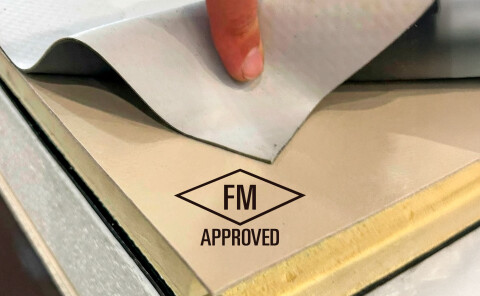
Install AllShield BarrierSheet together with PIR insulation in one run
On large PV roofs, installation speed matters as much as fire performance. At Intersolar, we showed how AllShield BarrierSheet can be installed together with PIR insulation in one run, using standard fastening equipment. No extra tools. No second round. Faster workflow, same crew, fire-safe roof assembly.
On large industrial roofs, small installation details can have a major impact on labour time and total project cost. At Intersolar in Germany, Eurofast demonstrated a simple but highly practical approach: AllShield BarrierSheet can be mechanically fixed using the exact same equipment and fastening method as PIR insulation boards.
No additional tools.
No pre-drilling.
No separate installation round.
One workflow for insulation and fire mitigation
In practice, this means: PIR insulation and the AllShield BarrierSheet cover board are installed in one continuous run using standard roofing screws and tube washers.
For contractors working on 10,000–20,000 m² distribution centres, this is not a marginal improvement. It directly affects:
-
Installation speed
-
Labour planning
-
Crane movements and logistics
-
Overall project sequencing
-
Total installed cost per m²
Fire mitigation only works at scale if it integrates seamlessly into the existing roofing workflow.
No change to tools, no change to crew
The key advantage is not only technical compatibility, but operational simplicity:
-
Same crew
-
Same fastening equipment
-
Same fixing pattern
-
No additional trade or mobilisation
Because the AllShield BarrierSheet is lightweight and mechanically fixed it behaves like a cover board within the standard roofing process, not as an additional complex fire protection system.
Tested performance at system level
Ease of installation must always be combined with proven performance.
Large-scale fire testing has shown that the AllShield BarrierSheet effectively prevents direct flame penetration into deeper structural layers in rooftop PV fire scenarios.
In addition, the product is:
-
FM 4470 Approved
- FM 4478 Approved for roof-mounted PV systems
This ensures compatibility with Class 1 roof constructions and photovoltaic assemblies under FM standards.
When should you consider this approach?
Combining insulation and fire mitigation in one installation step is particularly relevant when:
-
Retrofitting large industrial roofs with photovoltaic systems
-
Working within tight installation schedules
-
Minimising labour cost and crane time is critical
-
Insurance requirements demand FM 4478 Approved roof assemblies
In these projects, the question is not only whether the roof is fire-safe, but whether the fire mitigation solution fits the contractor’s workflow.
Sometimes progress is not about adding another product. It is about removing friction from the installation process.
Our roof fire 🔥 protection solutions
Fire safety is the goal, insurability is the result
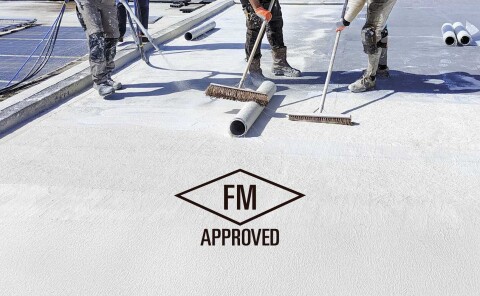
Flat roofs – especially those with solar panels – face an increasing fire risk. Even the best fire-retardant membranes offer limited protection against flying sparks or thermal ignition beneath PV panels. That’s why AllShield developed two non-combustible fire protection systems, each tailored to a specific application.
Do you have any questions for us?
We're here for you!
