
Discover our solutions for fully fire-safe 🔥 roofs
1-11-2024
Insuring solar panel roofs: insights from Solarif on AllShield Blue
What do solar insurers say about roof fire safety? We asked Solarif – the experts in PV insurance. Their advice: make your roof non-combustible. AllShield Blue ticks that box, keeping your solar-covered roof truly fire safe.
Solarif: a unique perspective on PV risk
Solarif is a leading independent specialist in solar energy insurance and certification. When we spoke with their team about AllShield Blue, they provided invaluable insights into why roof non-combustibility is so crucial. Below, we summarize Solarif’s key points and frequently asked questions from their discussions with us.
Why is having a non-combustible roof so important?
Solarif: Because it’s the difference between a minor incident and a total loss. AllShield Blue is unique in that it is truly A1 non-combustible – it adds no fuel to a fire. This coating shields the flammable insulation and membrane underneath, so they don’t ignite. In contrast, “fire-resistant” finishes that are merely retardant can still smolder and eventually burn, ultimately setting the whole roof (and building) on fire. Non-combustibility means a rooftop fire stays very limited, goes out on its own, or never starts at all. This dramatically lowers the risk profile for insurers.
Does the coating affect the roof’s waterproofing or firefighting?
Yes – in a positive way. AllShield Blue preserves the roof’s waterproof layer beneath it. Unlike a conventional bitumen roof cover that might melt or burn through, the coated roof keeps its integrity during a fire. This means firefighters can safely use water from above to extinguish flames without flooding the interior of the building.
(One critical safety note: firefighters must still disconnect the PV system and avoid standing in pooling water while the system is energized.) Essentially, the coating prevents the scenario where a small fire leads to major water damage because the roof opened up – a big relief for insurers.
How long and how much heat can AllShield Blue withstand?
This is somewhat a trick question. Because the coating eliminates the roof as fuel, a fire doesn’t really “take hold,” so questions of duration or max temperature become less relevant. It’s like asking how long a metal tray can hold a fire – the fire will die out rather than push the limits of the tray.
AllShield Blue has been tested up to 1300 °C, is completely flameproof, and doesn’t burn. So no matter what burning material lands on it, only that material burns out – the roof beneath stays protected.
Isn’t complying with electrical codes (like Scope 12) enough for fire safety?
Electrical standards (e.g. NEC, Scope 12, etc.) are essential for reducing risk, but they don’t guarantee prevention of all fires. Solarif emphasizes that AllShield Blue makes your roof inherently safe. Even if there’s an electrical fault, an external fire (like “flying fire” embers from elsewhere), or any mishap, no big fire will develop because the roof itself won’t catch. It’s a critical extra layer of security beyond what design codes cover.
Can AllShield Blue handle extreme PV hazards like arc flashes?
Absolutely. The coating is designed to resist the intense temperatures produced by an electrical arc (plasma discharge) and prevent it from igniting the roof. In practice, this means even a worst-case arc-fault under a panel won’t start a rooftop fire – the arc might singe the coating, but the flame won’t spread or penetrate. This is a big reassurance, since DC arc flashes are among the more severe fire threats in PV systems.
Does it protect against fire from outside (like fireworks or burning debris)?
Yes – AllShield Blue is extremely suited to resist fires caused by external sources. It’s tested to ~1300 °C, flame-tight, fire-resistant, and non-combustible. So regardless of what burning material lands on the roof (fireworks, airborne embers, etc.), that object will burn out on top of the coating. The roof structure and PV system remain safe and untouched behind AllShield’s protective barrier.
Making solar roofs insurable
Solarif’s insights boil down to a simple principle: if the roof can’t burn, a solar installation on it becomes far less risky to insure. An unprotected bitumen roof with PV is a red flag for many underwriters, but a bitumen roof coated with AllShield Blue is viewed in a completely different light. It transforms a high fire-risk installation into a manageable one.
This is why Solarif and other insurers are keen on solutions like AllShield – they dramatically reduce potential loss scenarios. In fact, Solarif helped us understand and articulate these benefits better, reinforcing how our product adds value to anyone concerned with solar panel fire safety and insurance.
By incorporating AllShield Blue, businesses with rooftop solar can demonstrate to insurers that they’ve mitigated the primary fire hazard of PV systems: the combustible roof itself. The result is often smoother insurance approval, potentially better premiums, and greater peace of mind for all parties involved. As Solarif’s feedback highlights, non-combustibility is the gold standard – and AllShield Blue delivers exactly that.
Blue or AllShield BarrierSheet: choosing the right approach
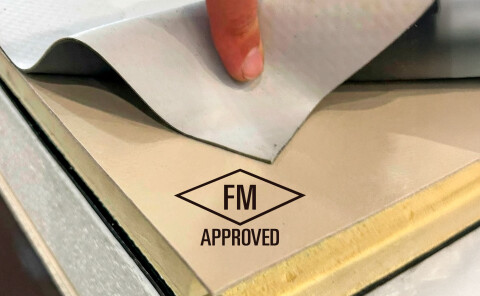
While AllShield Blue is ideal for upgrading existing roofs that remain waterproof, AllShield AllShield BarrierSheet provide the same A1 non-combustible protection as a structural board beneath the waterproofing system.
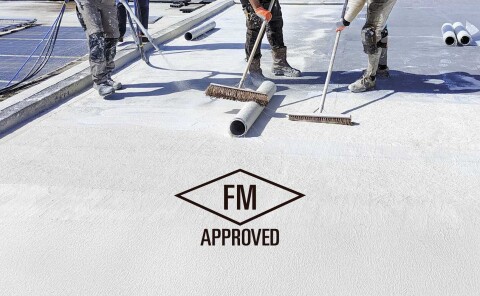
- Use AllShield Blue when you want to fireproof a still watertight bitumen or PVC roof without removing the existing cover. It turns a combustible surface into a non-combustible one and makes it safe for solar.
- Use AllShield AllShield BarrierSheet when constructing new roofs or during major renovation. The board sits directly on top of the insulation, ensuring the entire build-up beneath the waterproofing is fuel-free from the start.
Both approaches achieve the same outcome: insurers see a roof that cannot fuel a fire, making solar installations safer and insurable. The choice depends on whether you are working with an existing roof that needs upgrading, or building new.
Our roof fire 🔥 protection solutions
Fire safety is the goal, insurability is the result
Flat roofs – especially those with solar panels – face an increasing fire risk. Even the best fire-retardant membranes offer limited protection against flying sparks or thermal ignition beneath PV panels. That’s why AllShield developed two non-combustible fire protection systems, each tailored to a specific application.
Do you have any questions for us?
We're here for you!
