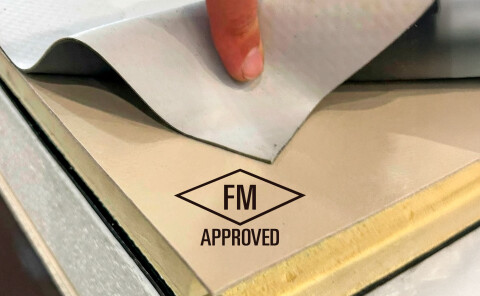

Discover our solutions for fully fire-safe 🔥 roofs
21-1-2026
Is AllShield BarrierSheet a cement board alternative for fire protection under PV?
Is a cement board required for fire protection under PV systems on flat roofs? This knowledge article explains whether AllShield BarrierSheet can be used as an alternative and how both solutions compare in function performance and roof load.
When improving fire safety on flat roofs with photovoltaic systems it is common to receive advice to install a cement board beneath the roof membrane. This often leads to practical questions. Is AllShield BarrierSheet a cement board? Can it be used instead of a traditional cement board? And what are the differences in application and performance? This page provides a clear and practical explanation.
Is AllShield BarrierSheet a cement board?
AllShield BarrierSheet is not a traditional cement board. It is however a mineral non-combustible board that fulfils the same role within a roof build-up.
A conventional cement board is typically a fibre cement board developed for structural support or levelling purposes. BarrierSheet was developed from a different starting point: controlling fire risk in flat roofs specifically in combination with photovoltaic installations.
Both products are non-combustible and are installed as a layer within the roof build-up but they are designed with a different focus.
Can BarrierSheet be used instead of a cement board?
Yes. In situations where a cement board is recommended as a fire protection layer beneath PV systems BarrierSheet can fulfil the same functional role and in many cases more.
Where a cement board primarily acts as a robust non-combustible board BarrierSheet is designed as an active fire barrier. This means the board not only does not burn itself but is specifically intended to limit flame penetration into the insulation and roof structure below.
This makes BarrierSheet well aligned with the original purpose for which a cement board is often specified: controlling fire risk beneath photovoltaic systems.
The key differences explained
Weight and roof load
A cement board is relatively heavy often 10 to 15 kg per m² or more. BarrierSheet weighs approximately 3.0 kg per m². This makes BarrierSheet particularly suitable for lightweight roof constructions or roofs where additional load is undesirable.
Design intent
Cement boards are primarily developed for structural stability and surface levelling. Fire resistance is a material property. BarrierSheet is developed with fire control as its primary objective specifically addressing fires that originate beneath PV installations.
Behaviour in a PV fire scenario
For cement boards the behaviour of the complete roof system during a PV-related fire is often not tested or documented. BarrierSheet has been tested in realistic roof assemblies with photovoltaic systems focusing on fire spread and protection of underlying layers.
System approach
A cement board is usually assessed as an individual material. BarrierSheet is designed and tested as part of a complete roof build-up which aligns with how insurers and risk engineers evaluate roofs with PV.
| Aspect | Cement board | BarrierSheet |
| Non-combustible | Yes | Yes |
| Weight | High | Low |
| Developed for PV | Not specifically | Specifically |
| Primary function | Structural and levelling | Fire barrier layer |
| Tested in PV roof assemblies | Limited | Yes |
| Suitable for lightweight roofs | Sometimes limited | Well suited |
What this means for advice to install a cement board
If the advice is to install a cement board for fire protection beneath photovoltaic systems the objective is clear: limiting fire spread and protecting the roof construction.
BarrierSheet achieves the same objective while adding the benefit of a significantly lower weight and documented performance in roof-PV fire scenarios. It therefore does not deviate from the intent of the advice but offers an alternative that better aligns with current requirements for fire safety roof load and insurability.
Summary
AllShield BarrierSheet is not a traditional cement board but it fulfils the same function as a fire protection layer beneath PV systems. Thanks to its low weight focus on fire control and system-level test results BarrierSheet is in many cases a practical and equivalent alternative to a traditional cement board for flat roofs with photovoltaic installations.
Our roof fire 🔥 protection solutions
Fire safety is the goal, insurability is the result
Flat roofs – especially those with solar panels – face an increasing fire risk. Even the best fire-retardant membranes offer limited protection against flying sparks or thermal ignition beneath PV panels. That’s why AllShield developed two non-combustible fire protection systems, each tailored to a specific application.
Do you have any questions for us?
We're here for you!
