
Discover our solutions for fully fire-safe 🔥 roofs
30-4-2026
RC62 fire safety for PV panels in the UK: making roofs insurable
RC62 is changing how insurers assess PV roofs in the UK. One key takeaway: avoid combustible roof build-ups. But what if your roof already contains them? Here’s how to control fire risk and make existing roofs insurable under RC62.
Is your PV roof actually insurable under RC62?
Across the United Kingdom, more companies are turning their roofs into energy-producing assets.
But insurers are asking a different question:
Can this roof actually be insured once PV is installed?
RC62, developed by the Fire Protection Association (FPA) and RISCAuthority, is quickly becoming the reference for that decision.
And its message is uncompromising:
“The fitting of PV panel installations to combustible roofs should be avoided wherever possible.”
If your roof contains PIR, EPS or bitumen, that puts you directly in scope.
The real risk: not the panels, but the roof
Most PV discussions focus on:
electrical faults
connectors
installation quality
But RC62 shifts the focus to something more fundamental:
fire behaviour of the roof system itself
Because once a fire starts:
PV increases heat and energy input
insulation becomes fuel
fire spreads beneath the panels
At that point, compliance is irrelevant.
The roof either stops the fire or feeds it.
What RC62 really requires
RC62 is clear:
New rooftop PV installations shall not reduce the fire performance of the roof. If installed on a combustible roof, a fire-resistant covering should be applied.
This creates a practical challenge:
most existing industrial roofs are combustible
full roof replacement is expensive and disruptive
insurers still expect risk mitigation
So the question becomes:
how do you make an existing roof insurable without rebuilding it?
The solution: control the fire at system level
There is only one effective strategy:
introduce a non-combustible barrier in the roof build-up
Not as an add-on.
But as a system-level intervention.
This prevents:
flame penetration into the structure
fire spread through insulation
escalation into full roof involvement
It changes the outcome of a fire.
AllShield BarrierSheet: proven under real fire conditions
AllShield BarrierSheet is designed specifically for this purpose.
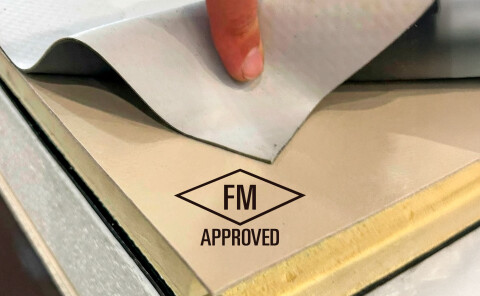
It is a non-combustible (A1) mineral board that:
blocks vertical fire penetration
interrupts horizontal fire spread
maintains roof integrity under PV
Unlike theoretical solutions, BarrierSheet has been tested in large-scale PV fire scenarios.
The results:
fire remains localised
structural layers are protected
the fire runs out of fuel when the chain is broken
This is exactly what RC62 aims to achieve.
Why this matters for your project
Without a non-combustible solution:
insurers may reject the risk
additional conditions or premiums may apply
project timelines may be delayed
long-term exposure remains
With BarrierSheet:
you align with RC62 expectations
you reduce fire spread risk
you strengthen your insurance position
you enable PV installation on existing roofs
Stop guessing what insurers want!
RC62 is no longer theoretical guidance.
It is already influencing real underwriting decisions.
If you are planning:
a new PV installation
a retrofit on an existing roof
or an insurance renewal
You need clarity on one thing:
does your roof system control fire, or contribute to it?
We work with building owners, installers and insurers to make PV roofs compliant and insurable.
Want to know if your roof meets RC62 expectations?
Request a quick roof risk assessment or contact our technical team directly via our contact page.
We will show you where your risks are, how they affect insurability and how BarrierSheet solves them.
Our roof fire 🔥 protection solutions
Fire safety is the goal, insurability is the result
Flat roofs – especially those with solar panels – face an increasing fire risk. Even the best fire-retardant membranes offer limited protection against flying sparks or thermal ignition beneath PV panels. That’s why AllShield developed two non-combustible fire protection systems, each tailored to a specific application.
Do you have any questions for us?
We're here for you!
