
Discover our solutions for fully fire-safe 🔥 roofs
14-9-2025
Solar Roof Fires: Insights from ESFSS 2025 – Why Non-Combustible Roofs Are the Only Real Solution
At ESFSS 2025, ZAG, Istituto Giordano and global researchers confirmed: PV faults are inevitable. But only non-combustible roofs stop them from escalating into catastrophic fires. AllShield BarrierSheet & Blue deliver the protection insurers demand.
ESFSS 2025 and solar panels
At the European Symposium on Fire Safety Science (ESFSS 2025), several leading research groups presented their latest findings on the fire risks associated with photovoltaic (PV) systems on flat roofs. Their work confirms what many insurers and risk managers already fear: even with inspections and standards, PV faults are inevitable — and the decisive factor is whether the roof beneath is combustible.
Scientific Insights Presented at ESFSS 2025
1. System-level testing reveals hidden risks
Dr. Andrea Jurov and colleagues from the Slovenian National Building and Civil Engineering Institute (ZAG) emphasized that testing only PV components (panels, cables, membranes) underestimates real fire behavior. Their experiments in ZAG’s Fire Laboratory showed that “the interaction of PV modules with roof membranes and insulation creates new flame spread mechanisms invisible at component level”. They advocate full system-level fire testing of roof-PV assemblies, capturing ignition, flame spread, and heat transfer across layers.
2. National statistics show alarming fire rates
Dr. Nik Rus (ZAG & University of Primorska) together with Vincenzo Puccia (Italian National Fire Brigade) presented fire data: Italy sees ~10 PV rooftop fires per GW annually, Slovenia ~37 per GW, compared to an international average of 29. Rus concluded: “Observed risk levels are in the order of 10⁻⁴ — far higher than acceptable thresholds — demanding urgent management action.”
3. PV above roofs accelerates fire spread
Giombattista Traina (Istituto Giordano, Italy) and his team proposed new methodologies (CEI TS 82-89) combining cone calorimeter and outdoor tests. They found that “heat accumulation beneath PV modules significantly accelerates fire spread across combustible roof surfaces”. Protective top layers and non-combustible inserts proved decisive.
4. Damage characteristics of PV modules
Prof. Jinlong Zhao (China University of Mining & Technology, Beijing) and Prof. Grunde Jomaas (ZAG/University of Primorska) showed experiments mapping PV fire damage zones. They demonstrated that glass breakage, blistering, and hotspot fragmentation create cascading ignition pathways. Zhao noted: “Traditional detection systems miss these dynamics — risk mitigation must focus on preventing roof involvement.”
Implications for Commercial Roofs with PV
-
PV faults are unavoidable: connectors, hotspots, cable damage will occur during a 25–30 year lifespan.
-
Roof combustibility is decisive: bitumen, EPS, or polymer insulation transform small electrical faults into large-scale roof fires.
-
Insurers are tightening acceptance: as data accumulates, many refuse PV projects on combustible roof decks unless additional fire barriers are proven.
The AllShield Approach
The research presented at ESFSS confirms the foundation of AllShield’s mission: make roofs non-combustible.
-
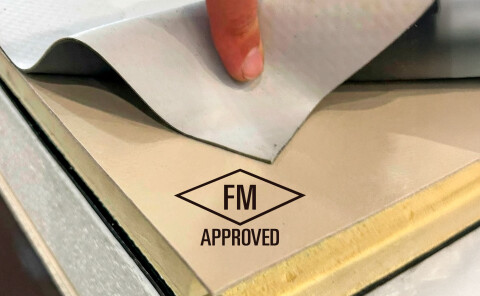
AllShield BarrierSheet: a mineral, non-combustible insert that blocks flame penetration. Proven in ZAG and NEN 7250:2021 tests, it ensures that even PV-driven flames self-extinguish at the barrier.
-
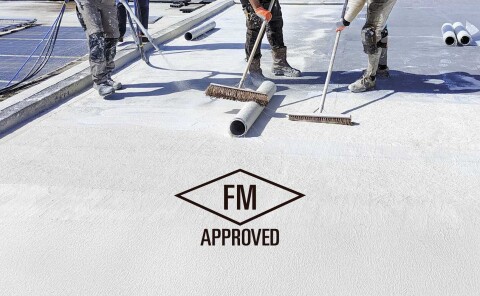
AllShield Blue: a high-performance coating that transforms existing bitumen roofs into functionally non-combustible systems, extending roof life and boosting PV yield.
Together, they provide what the symposium identified as missing: a roof that does not fuel the fire.
The results
From Slovenia to Italy to China, researchers at ESFSS 2025 delivered the same message:
-
PV fires will continue to occur.
-
Combustible roofs guarantee escalation.
-
Non-combustible roofs are the only reliable solution.
Our roof fire 🔥 protection solutions
Fire safety is the goal, insurability is the result
Flat roofs – especially those with solar panels – face an increasing fire risk. Even the best fire-retardant membranes offer limited protection against flying sparks or thermal ignition beneath PV panels. That’s why AllShield developed two non-combustible fire protection systems, each tailored to a specific application.
Do you have any questions for us?
We're here for you!
