
Solar panels on commercial roofs: fire-safe and insurable with AllShield
How do you make your large flat roof with PV insurable?
Our solutions turn roofs with PV from an unacceptable risk into an insurable roof system. Mineral fire protection designed to limit fire spread under PV arrays and support insurer acceptance, aligned with the FM Approvals approach and RoofNav conventions.


Why insurers restrict PV on large roofs
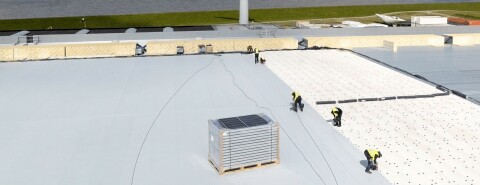
PV systems can fail, even with high-quality components, monitoring and inspections. Electrical faults, connector issues and installation defects can lead to ignition events under the array. The practical underwriting question is therefore not whether ignition can be prevented in every case, but whether the roof system limits fire spread under the PV array and prevents flame penetration into combustible layers.
The defensible route is simple. Make the roof system functionally non-combustible beneath PV arrays so a local incident stays local.
Preferred solution route
There are three practical situations for roofs with PV.
- The roof system is already functionally non-combustible.
- Add a mineral roof-PV coating where applicable.
- Add a mineral cover board as part of the roof system.
Preferred route
Where a roof build-up can be defined and detailed, the mineral cover board approach is the preferred risk position because it is a robust, system-based method with clear documentation for insurer and risk engineer review.
The cover board route
For large commercial roofs, the most repeatable way to make the roof system functionally non-combustible under PV is to integrate a mineral cover board into the build-up.
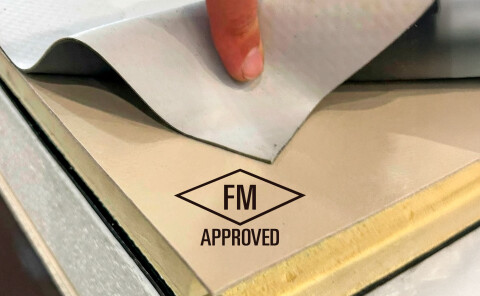
AllShield BarrierSheet is a mineral cover board that is FM 4470 Approved and FM 4478 Approved. It is used to create a functionally non-combustible barrier layer beneath PV arrays to limit fire spread and prevent flame penetration into lower structural layers.
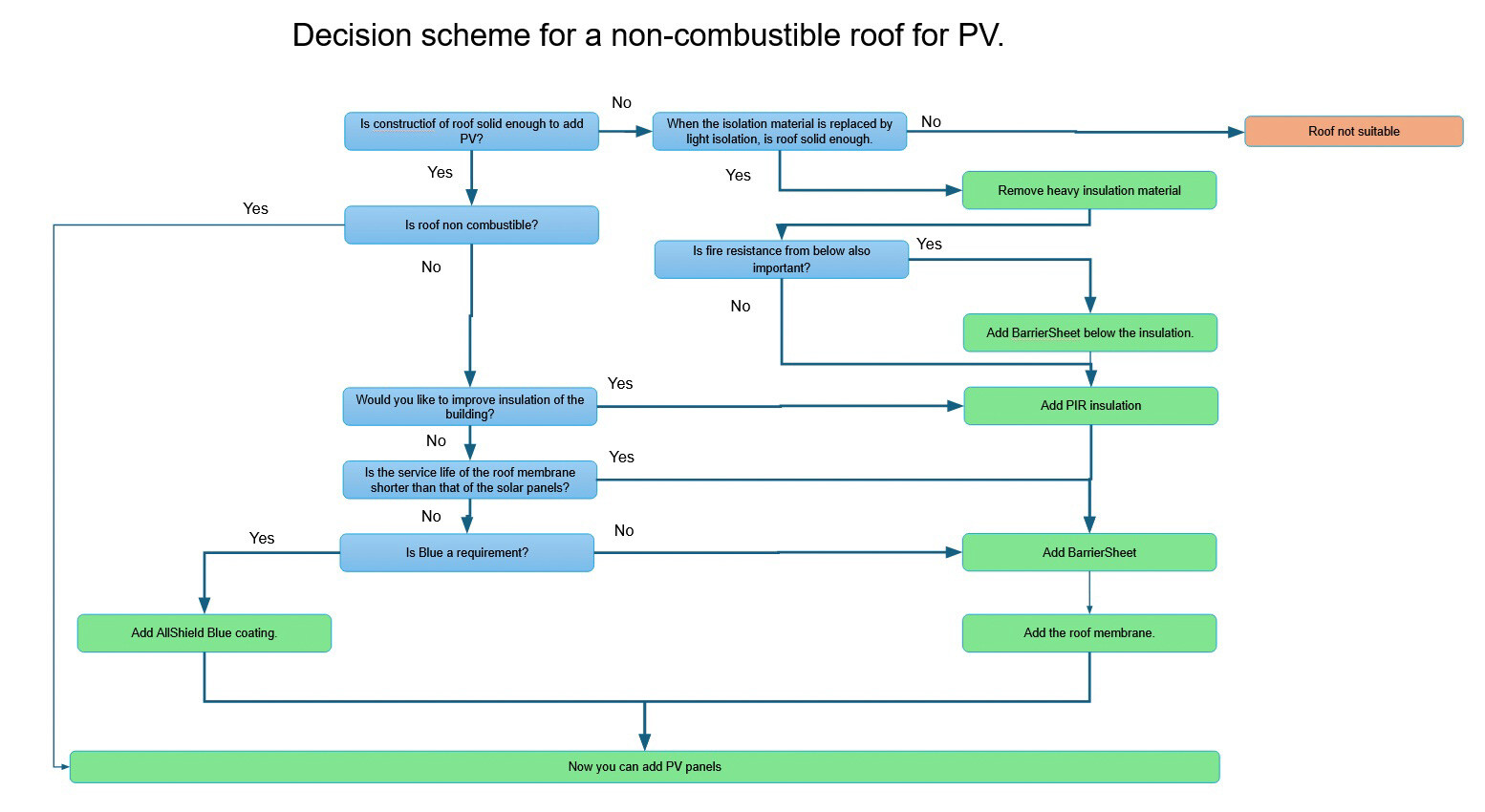
Flowchart
Use this flowchart to select the preferred cover board route or, where applicable, a coating route, with the end goal of adding PV safely and insurably. 🔍 Click on the image to enlarge.
When a coating route can be used
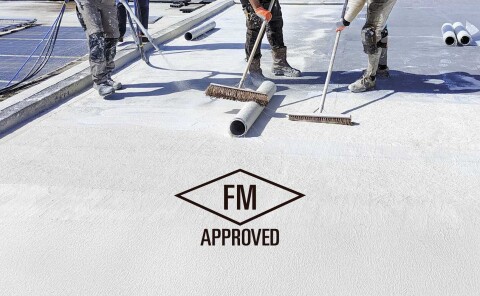
For retrofit projects where the existing roof assembly remains in place and a coating solution is suitable, an FM 4484 Approved mineral roof-PV coating can be used to create a functionally non-combustible barrier layer beneath the PV array.
Important limitation
On roofs with composite or insulated metal roof panels, a coating route is not applicable. In those cases the cover board route is required.
What to share with your insurer
Insurers do not advise products. They assess whether your roof can be made fire-safe and insurable for PV based on a defined roof system, documentation and workmanship control.
Use this fixed wording in your email or project note
Ask your insurance engineer to assess whether your roof can be made fire-safe with FM 4478 Approved BarrierSheets in a way that will allow insurance coverage when adding PV.
Next step
If you already know your roof build-up, use the flowchart to select the route and request a project review so the defined build-up, detailing and workmanship control requirements can be confirmed.
Our roof fire 🔥 protection solutions
Fire safety is the goal, insurability is the result
Flat roofs – especially those with solar panels – face an increasing fire risk. Even the best fire-retardant membranes offer limited protection against flying sparks or thermal ignition beneath PV panels. That’s why AllShield developed two non-combustible fire protection systems, each tailored to a specific application.
Request my risk scan

