
Discover our solutions for fully fire-safe 🔥 roofs
11-9-2025
BarrierSheet: Fire-safe roof systems for the solar era
Flat roofs with PV systems carry far higher fire loads than bare roofs. Even Class A roof buildups can fail insurers’ criteria. BarrierSheet inserts a mineral, non-combustible barrier that stops fire penetration. ZAG testing confirms: flames extinguish and spread is eliminated.
The PV roof fire challenge
Fire testing standards such as Broof(t1) o
r EN 13501-1 were designed for roofs without solar panels. They simulate embers or small flames lasting 10 minutes. With PV installed, conditions change drastically:
- Sustained ignition – arc faults in connectors can burn for 10–30 minutes.
- Higher heat flux – flames trapped under panels create 2–3× higher local temperatures.
Increased fuel inputs – molten plastic dripping from modules onto membranes initiates and prolongs ignition.
This is why insurers report: even Class A roof buildips are not sufficient when added PV. The conditions have changed.
Why roofs fail under PV fires
- PVC/TPO membranes: Class B/C, calorific value ~18–20 MJ/kg. Tend to smoulder; low fuel contribution.
- Bitumen membranes: Class B/C, ~40–42 MJ/kg. Ignite readily, drip burning fuel, propagate fire.
- EPS insulation: Class E/F, ~42 MJ/kg. Ignites violently, horizontal flame spread rapid.
- PIR/PUR insulation: Class C/D, ~28–32 MJ/kg. Sustains fire, releases dense smoke.
- Mineral wool insulation: Class A1, ~0 MJ/kg in theory. But in practice, many boards are laminated with adhesives or binders. If flames reach these seams, the glue can smoulder and allow horizontal fire spread, undermining the expected safety of mineral wool systems. The mineral wool traps the heat internally and makes for a longer ‘hot’ roof needing more water to cool down. The fire brigade usually has to open the roof on multiple locations outside the original fire zone and use water to cool down. This cooling down is difficult to achieve since the water has to penetrate in between the layers. The mineral wool will need to absorb the water, creating a heavier load on the roof with the risk of sagging or collapsing and more damage due to water inside the building.
The catastrophe occurs when fire breaches the membrane and exposes insulation or adhesives. Then the roof itself becomes the fuel bed for lateral spread.
How BarrierSheet breaks the chain
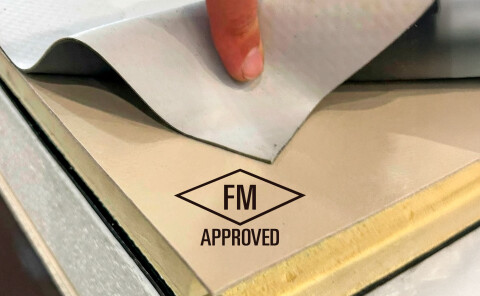
AllShield BarrierSheet is a 2.5 mm mineral, A1-classified board, installed directly beneath the membrane.
- Blocks penetration – fire cannot pass to insulation.
- Seals combustible cores – EPS, PUR, PIR and even mineral wool adhesives are kept out of the fire scenario.
- Membrane smouldering irrelevant – PVC above may char, but its calorific contribution is negligible.
- Stops lateral spread – with no fuel exposed, fire cannot travel across the roof.
Even with laminated mineral wool boards, BarrierSheet ensures adhesives or binders are never exposed to flames.
Proven in testing
- ZAG (Slovenian National Building and Civil Engineering Institute): full-scale PV fire simulations confirmed no horizontal fire spread. Flames self-extinguished once ignition ceased.
- NEN 7250:2021: tested for PV roof fire safety.
- Broof(t1): achieved in system-level roof testing.
Insurance perspective
For insurers, the difference is stark:
- Without BarrierSheet: PV fault ignites insulation → roof-wide fire → €10–20M loss.
- With BarrierSheet: ignition remains superficial; fire self-extinguishes; losses limited to a few m².
Major insurers already advise non-combustible cover boards under PV. BarrierSheet fulfils this function with independent test data.
Comparative Fire Behaviour Table
|
Material/System |
Euroclass |
Calorific Value (MJ/kg) |
Fire Behaviour without BarrierSheet |
With BarrierSheet in Place |
|
PVC membrane |
B / C |
~18–20 |
Smoulders, may ignite |
Smoulders only; no penetration |
|
Bitumen membrane |
B / C |
~40–42 |
Ignites, drips burning fuel |
Sealed; no spread |
|
EPS insulation |
E / F |
~42 |
Violent ignition, lateral spread |
Never exposed |
|
PIR/PUR insulation |
C / D |
~28–32 |
Sustains fire, dense smoke |
Never exposed |
|
Mineral wool (laminated) |
A1 (wool) |
~0 (wool only) + adhesives |
Wool inert, but adhesives can smoulder → horizontal spread |
Never exposed; adhesives irrelevant |
|
BarrierSheet |
A1 |
~0 |
Non-combustible barrier |
Stops penetration & lateral spread |
AllShield guards your roof
BarrierSheet ensures that even under PV-driven fire loads, flames do not propagate. Yes, membranes above may smoulder, and even adhesives within mineral wool could smoulder if exposed — but with BarrierSheet, these layers are never reached.
Independent ZAG and Kiwa NEN 7250:2021 testing confirm: PV fires self-extinguish at the barrier.
For risk managers and insurers, the conclusion is clear: BarrierSheet delivers functional non-combustibility, turning any roof, even with combustible insulation, into a safe and insurable platform for solar energy.
Our roof fire 🔥 protection solutions
Fire safety is the goal, insurability is the result
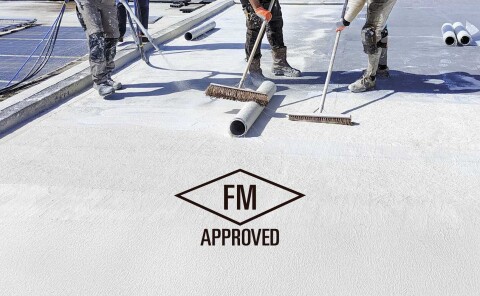
Flat roofs – especially those with solar panels – face an increasing fire risk. Even the best fire-retardant membranes offer limited protection against flying sparks or thermal ignition beneath PV panels. That’s why AllShield developed two non-combustible fire protection systems, each tailored to a specific application.
Do you have any questions for us?
We're here for you!
