
Discover our solutions for fully fire-safe 🔥 roofs
29-9-2025
Fire Safety Rules for Flat Roofs in Europe with and without PV
Flat roofs across Europe face different fire safety rules—with and without PV. From EN 13501-5 (t1–t4) to CLC/TR 50670, VdS Germany and Italy’s 2025 PV law. Discover how AllShield BarrierSheet, an A1 non-combustible cover board, complies in all EU + UK scenarios.
European roof fire safety requirements
The table below provides an overview of the fire safety requirements for flat roofs in Europe, divided into roofs without photovoltaic (PV) panels and roofs with PV panels.
The requirements are based on the European classification EN 13501-5, which is linked to the test methods from CEN/TS 1187. Each country has its own preference for a test variant (t1 through t4). This preference determines what evidence is required to classify a roof system as fire safe.
In addition, roofs with PV systems often require an extra assessment, because PV systems increase the risk of fire spread. Increasingly, the CLC/TR 50670 test method (gas burner under PV) is applied, or national guidelines are in force (such as in Germany via VdS Schadenverhütung GmbH and in Italy with new PV legislation starting September 2025).
The table shows:
-
Which basic requirements apply per country for roofs without PV.
-
Which PV-specific requirements apply.
-
Whether the AllShield BarrierSheet complies in both cases.
Detailed Explanation
1. European System
EN 13501-5 determines the fire classification of roofs under external fire exposure.
CEN/TS 1187 describes four test methods (t1 through t4). Each country adopts a preferred method:
-
t1 (e.g., DE, NL, BE, LU, PL, CZ, SK, HU, SI)
-
t2 (Scandinavia + Baltic states)
-
t3 (FR, IT, ES, PT, GR)
-
t4 (UK, IE, CY, MT)
All methods result in the same classification, for example BROOF(t1) or BROOF(t4). There is no hierarchy; the chosen variant is purely a national choice based on weather influences and geographical conditions.
2. Difference With and Without PV
-
Without PV: only the national BROOF(tX) requirement applies.
-
With PV: additional tests or guidelines are often required, since PV panels increase flame spread and heat flux.
Many countries refer to CLC/TR 50670, which describes test methods and evaluation criteria for the fire safety of roofs with PV panels. It supplements existing standards such as EN 13501-5 (BROOF(t1–t4)), since those only consider the roof itself and not the extra risks introduced by PV systems.
-
Germany also refers to VdS 3145 for PV systems.
-
Italy has new PV legislation (effective September 2025) including requirements for compartmentation, spacing, and design.
3. Application of AllShield BarrierSheet
The BarrierSheet is an A1-classified cover board (non-combustible, tested according to EN 13501-1, NEN 1716 and Efectis).
-
Thanks to its A1 classification, the BarrierSheet complies with fire safety requirements for roofs without PV in all EU countries + UK.
-
With PV installations, the BarrierSheet also complies, provided tests are carried out in line with CLC/TR 50670 or equivalent protocols. These tests have been conducted at KIWA-BDA and ZAG.
4. Relevance for Insurers and Building Owners
More and more insurers require demonstrable BROOF classification with PV. BarrierSheet makes it possible to safely install PV systems even on light or combustible substructures (EPS, PUR/PIR, bitumen/EPDM). This creates an insurable, reusable, sustainable, and future-proof solution for industrial and commercial roofs across Europe.
| AT | EN 13501-5, t1 | Project/insurer | ✅ A1 compliant | ✅ tested, compliant TR 50670 |
| BE | EN 13501-5, t1 | TR 50670 extra | ✅ | ✅ |
| BG | EN 13501-5 | none | ✅ | ✅ |
| HR | EN 13501-5 | none | ✅ | ✅ |
| CY | EN 13501-5, t4 (UK-line) | extra PV check | ✅ | ✅ |
| CZ | EN 13501-5, t1 | none | ✅ | ✅ |
| DK | EN 13501-5, t2 | TR 50670 | ✅ | ✅ |
| EE | EN 13501-5, t2 | same | ✅ | ✅ |
| FI | EN 13501-5, t2 | same | ✅ | ✅ |
| FR | EN 13501-5, t3 | TR 50670 | ✅ | ✅ |
| DE | EN 13501-5 + DIN 4102-7, t1 | VdS 3145 | ✅ (A1 = harte Bedachung) | ✅ (TR 50670/VdS) |
| GR | EN 13501-5, t3/t4 | extra PV check | ✅ | ✅ |
| HU | EN 13501-5, t1 | none | ✅ | ✅ |
| IE | EN 13501-5, t4 | same | ✅ | ✅ |
| IT | EN 13501-5, t3 | New PV law (Sept 2025) | ✅ | ✅ (A1 meets new law) |
| LV | EN 13501-5, t2 | same | ✅ | ✅ |
| LT | EN 13501-5, t2 | same | ✅ | ✅ |
| LU | EN 13501-5, t1 | same | ✅ | ✅ |
| MT | EN 13501-5, t4 | same | ✅ | ✅ |
| NL | EN 13501-5, t1 | TR 50670 | ✅ | ✅ (A1 meets new law) |
| PL | EN 13501-5, t1 | same | ✅ | ✅ |
| PT | EN 13501-5, t3/t4 | same | ✅ | ✅ |
| RO | EN 13501-5 | none | ✅ | ✅ |
| SI | EN 13501-5, t1 | ZAG PV guideline | ✅ | ✅ tested |
| SK | EN 13501-5, t1 | same | ✅ | ✅ |
| ES | EN 13501-5, t1/t3 | TR 50670 | ✅ | ✅ |
| SE | EN 13501-5, t2 | same | ✅ | ✅ |
| UK | EN 13501-5, t4 mandatory | MCS/PV extra | ✅ | ✅ |
CountryBasic (no PV)PV-specificBarrierSheet without PVBarrierSheet with PV
| CLC/TR 50670 | European guideline for roofs with PV panels | Roof build-up + PV array (modules, mounting) | External fire, flame spread, ventilation effect | Reference document: insight into PV influence on roof fire behaviour. No formal classification. | CENELEC Technical Report (not a norm, supportive). |
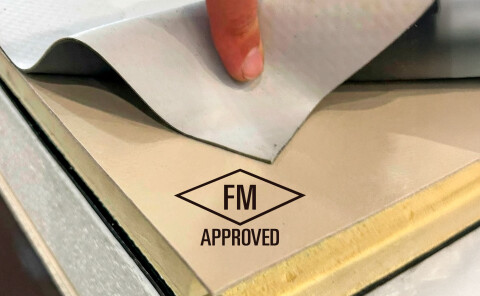
| FM 4470 | Roof assemblies without PV | Roof build-up (insulation + cover board + membrane) | External & internal fire, wind uplift, hail impact | FM Approval of complete roof assemblies without PV. | FM mandatory for insurable non-PV roofs. |
| FM 4478 | Roof assemblies with PV | Roof build-up + PV modules + mounting system | Fire penetration, spread, wind uplift, impact | FM Approval of roof assemblies with PV. | FM mandatory for insurable PV roofs. |
Standard / GuidelineApplicationTest object(s)Fire scenariosPurpose / OutcomeStatus / Use
Notes
-
BarrierSheet without PV: always ✅, because the A1 classification + FM testing covers national requirements (t1–t4).
-
BarrierSheet with PV: also ✅, provided supported by CLC/TR 50670 or FM 4478 tests – these have already been done at KIWA/ZAG and are ongoing at FM.
Our roof fire 🔥 protection solutions
Fire safety is the goal, insurability is the result
Flat roofs – especially those with solar panels – face an increasing fire risk. Even the best fire-retardant membranes offer limited protection against flying sparks or thermal ignition beneath PV panels. That’s why AllShield developed two non-combustible fire protection systems, each tailored to a specific application.
Do you have any questions for us?
We're here for you!
