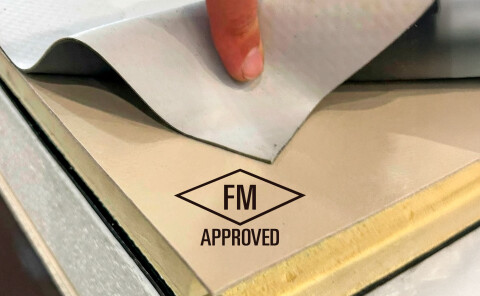

Discover our solutions for fully fire-safe 🔥 roofs
18-9-2025
Gypsum cover boards and the new AllShield BarrierSheet for PV roofs
Gypsum cover boards have long been used for roof fire protection, but they are heavy and time-limited. AllShield BarrierSheet is thinner, lighter, non-combustible and tested under PV fire scenarios—making it a proven solution for today’s flat roofs.
Flat commercial roofs are facing increasingly strict fire safety requirements, especially with the rapid growth of solar panel installations. For decades, gypsum-based boards have been used to improve the fire resistance of roof assemblies. Today, a new alternative is available: AllShield BarrierSheet.
This article compares gypsum cover boards with AllShield BarrierSheet, focusing on fire performance, weight, durability, and ease of installation.
How Gypsum Boards Work
Gypsum (calcium sulfate dihydrate) contains chemically bound water that evaporates in case of fire. This temporarily keeps the surface at around 100 °C. Once the water is gone (typically within 30–60 minutes), the gypsum loses strength, cracks, and disintegrates. Above 200–300 °C, the board usually degrades and can no longer provide effective fire resistance.
Examples of gypsum-based cover boards:
-
Products from well-known brands offering reinforced gypsum boards for fire and wind resistance.
-
Perlite–gypsum combinations often used for 30–90 minutes of fire resistance.
-
Glass-fiber reinforced gypsum boards commonly applied in fire-rated assemblies.
Although effective for short-term protection, these boards are heavy (typically 6–12 kg/m²), thick (6–15 mm), and can be unsuitable for older roofs with limited load-bearing capacity.
AllShield BarrierSheet: A Mineral Non-Combustible Solution
AllShield BarrierSheet is a mineral, non-combustible cover board designed specifically for roofing. The product has been tested at Efectis according to EN 13501-5 (Broof(t1)) and at ZAG Slovenia in PV fire scenarios. In these tests, the BarrierSheet consistently acted as an effective fire barrier, even under severe heat exposure.
Key benefits of BarrierSheet:
-
Thin and lightweight: approx. 2.5 mm thick and 3.0 kg/m².
-
Non-combustible: remains structurally intact under tested fire conditions, including exposures up to >1000–1300 °C.
-
PV fire tested: shown to prevent direct flame penetration into lower layers and to reduce fire spread into combustible insulation.
-
Moisture-tolerant: does not absorb water and is not affected by moisture during installation.
-
Easy installation: can be mechanically fixed with screws; no pre-drilling required.
Applications AllShield BarrierSheet
Renovation: Many older roofs contain EPS or bitumen insulation, both highly combustible. Because of their weight, gypsum boards may not be suitable in such cases. BarrierSheet offers comparable or greater fire protection at a much lower load, making it especially suitable for renovation projects.
New build: Insurers and building codes increasingly demand non-combustible roof layers under solar panels. BarrierSheet integrates seamlessly without adding significant thickness or requiring structural modifications.
Side-by-Side Comparison
| Property | Gypsum Cover Boards | AllShield BarrierSheet |
| Thickness | 6–15 mm | ~2.5 mm |
| Weight | 6–12 kg/m² | 3.0 kg/m² |
| Fire resistance mechanism | Temporary (water evaporation) | Non-combustible mineral, integrity maintained under tested fire exposure |
| Max. temperature | Typically degrades >200–300 °C | Withstands >1000–1300 °C (tested) |
| Duration in fire | Typically 30–90 minutes | Maintained performance during full test duration |
| Installation | Heavy, many fasteners needed | Lightweight, simple screw fixing |
| Suitability for old roofs | Risk of overload | Especially suitable due to low weight |
| Tested under PV | Limited | Yes, proven in dedicated PV fire tests |
Lighter, Stronger, Proven
Gypsum boards have long been used in roof fire protection but come with trade-offs: high weight, significant thickness, and limited duration of fire resistance. AllShield BarrierSheet changes the equation—thin, lightweight, non-combustible, and tested in PV fire scenarios.
For both renovation and new build, BarrierSheet provides a sustainable, insurer-friendly solution for improving the fire safety of flat roofs.
Our roof fire 🔥 protection solutions
Fire safety is the goal, insurability is the result
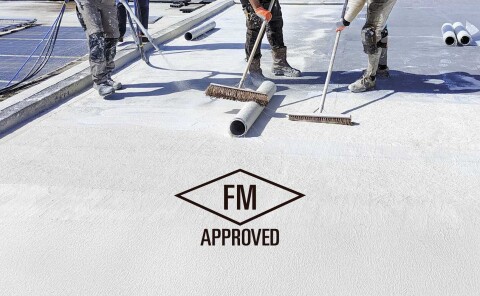
Flat roofs – especially those with solar panels – face an increasing fire risk. Even the best fire-retardant membranes offer limited protection against flying sparks or thermal ignition beneath PV panels. That’s why AllShield developed two non-combustible fire protection systems, each tailored to a specific application.
Do you have any questions for us?
We're here for you!
