
Discover our solutions for fully fire-safe 🔥 roofs
8-11-2025
QBE Insurance research: 60% increase in roof fires caused bij solar panels
New research by QBE Insurance shows a 60% rise in rooftop fires caused by solar panels. The main culprits: aging systems and combustible roofs. The solution is clear — install solar panels only on non-combustible surfaces like AllShield BarrierSheet or AllShield Blue.
New research from the international insurer QBE Insurance reveals that the number of fires caused by solar panels in the United Kingdom has risen by 60% in two years. While 107 incidents were registered in 2022, this number rose to 171 fires in 2024—an average of one solar panel fire every two days.
QBE based these figures on data obtained from UK fire services through Freedom of Information (FOI) requests. The increase is notable because the total number of solar panel installations grew by only 29% during the same period. In other words, the fire risk is escalating faster than the number of installations.
Most fires occurred in residential buildings, but incidents on commercial and industrial roofs are also increasing. According to QBE, the risk is “significant” for large roofs with solar panels, especially if these roofs contain combustible materials such as PIR or EPS insulation or bituminous membranes.
Older installations are the biggest risk factor
QBE's analysis shows that older solar panel installations are much more likely to cause fires than newer ones. The causes are usually:
-
Outdated or poorly maintained inverters.
-
Damaged or loose DC connectors.
-
Cables routed too close to combustible materials.
-
Lack of periodic inspection or cleaning.
As soon as an arc fault or short circuit occurs, a small defect beneath the panels can quickly escalate into a full-blown roof fire—especially if the substrate is combustible.
The fire hazard is not (only) in the PV panels
Although installation faults and wear are the direct cause, the roof's substrate determines whether a fire can spread.
-
Combustible roof insulation (such as PIR, EPS, or wood) can ignite in seconds once sparks or hot particles reach the surface.
Insurers and fire experts, therefore, draw the same conclusion: the only structural way to prevent fire spread is to use a non-combustible substrate.
This principle is already codified in the UK guideline RC62 (Recommendations for Fire Safety with Photovoltaic Panel Installations), drafted by the Fire Protection Association (FPA) and RISCAuthority. The guideline, now adopted by major insurers such as Zurich, Allianz, and Aviva, states:
"The fitting of PV panel installations to combustible roofs should be avoided wherever possible."
Non-combustible protection with AllShield
AllShield's products are engineered to solve exactly this problem: creating a non-combustible base beneath solar panels so that any potential fire cannot spread further.
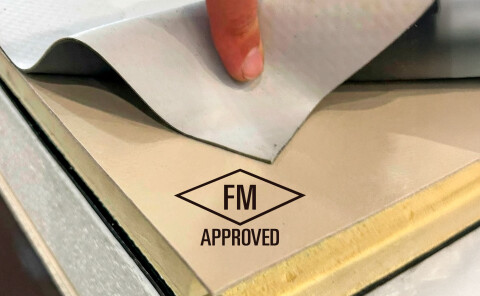
A mineral cover board weighing 3.0 kg/m2 that is installed beneath the roof membrane or on top of the insulation.
-
Completely non-combustible (A1 according to EN 13501-1).
-
Tested by Kiwa BDA according to CLC/TR 50670.
-
Complies with Broof (t1), DIN 18234, and VdS 3145.
-
Prevents flame penetration in all large-scale fire tests at ZAG Slovenia.
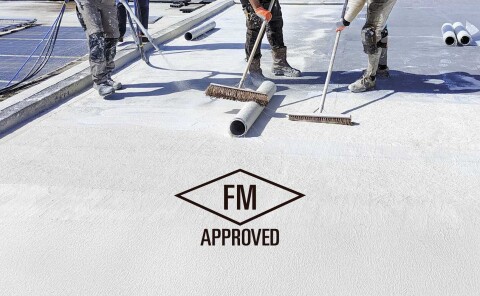
A two-component mineral-ceramic coating that easily makes existing roofs fire-safe via retrofit.
-
Resistant to temperatures above 1000 °C.
-
Tested by Kiwa BDA and Efectis.
-
Suitable for roofs with bitumen, concrete, wood, or EPS.
Both systems ensure that the roof surface beneath the solar panels cannot contribute to fire propagation—thereby meeting the requirements now explicitly demanded by insurers like QBE.
Growing Focus from Insurers and Risk Engineers
The QBE study marks a turning point. Fire risks on solar roofs are high on the agenda for insurers, fire services, and risk managers.
-
QBE itself warns that the “current installation standards are not adequate to prevent rapid fire spread” and explicitly recommends the use of fire-resistant barriers or non-combustible roof decks beneath PV installations.
-
In Continental Europe, more parties are adopting this stance. Germany, the Netherlands, and Italy are incorporating similar provisions into new guidelines and insurance terms.
The Message Is Clear
The energy transition demands millions of additional solar panels, but also thousands of safer roofs.
-
The QBE research makes it clear that fire safety is no longer a side issue—it is a prerequisite for insurability, continuity, and liability.
The solution is simple and proven: Only install solar panels on a non-combustible substrate.
With AllShield BarrierSheet and AllShield Blue, your roof remains safe, insurable, and ready for the future.
Our roof fire 🔥 protection solutions
Fire safety is the goal, insurability is the result
Flat roofs – especially those with solar panels – face an increasing fire risk. Even the best fire-retardant membranes offer limited protection against flying sparks or thermal ignition beneath PV panels. That’s why AllShield developed two non-combustible fire protection systems, each tailored to a specific application.
Do you have any questions for us?
We're here for you!
