
Discover our solutions for fully fire-safe 🔥 roofs
28-4-2026
Skylights in PV roof systems: the weakest link in fire performance and how to improve it
Skylights are designed to bring daylight into buildings, but within a PV roof system they can become the weakest link in a fire. The real question is no longer whether your roof is compliant, but whether it will hold when fire develops next to a skylight.
Skylights in PV roofs: a changing risk profile
Across Europe, the fire risk of industrial roofs is being reassessed. Especially in countries like Germany, authorities and insurers are tightening their focus on:
- large fire compartments
- combustible roof build-ups
- behaviour under sustained fire exposure
Now add PV to the equation.
You introduce continuous electrical energy, higher sustained temperatures and altered fire dynamics. Heat is retained longer and fire behaviour changes fundamentally.
Within this context, skylights are no longer neutral elements. They become part of the fire system.
Why skylight zones become the weakest link
In industrial roofs, skylights are rarely standalone elements.
They are embedded within complex roof systems that include:
- long continuous light strips
- combustible insulation layers
- mechanical fixings
- roof penetrations
This creates what fire engineers define as transition zones.
These zones combine:
- different materials
- interfaces and joints
- varying thermal expansion behaviour
- structural interruptions
Under fire exposure, systems tend to fail at these interfaces first.
Not because one component is insufficient.
But because the interaction between components is where stress concentrates.
What happens when a fire develops next to a skylight
If ignition occurs near a skylight within a PV roof system, several things can happen:
- heat accumulates under the PV array
- skylight materials soften or deform
- interfaces open or weaken
- fire bypasses the roof build-up
Instead of remaining on the surface, fire can:
- penetrate into deeper layers
- spread through combustible insulation
- enter the building below
In large logistics or industrial buildings, this rapidly escalates the risk profile.
What fire testing actually shows
This behaviour is not theoretical.
In large-scale rooftop fire tests at ZAG, systems were exposed to ignition scenarios exceeding standard fire loads.
The findings were clear:
- flame spread can be contained to the ignition zone
- vertical fire penetration can be prevented
- temperature peaks occur, but fire progression is limited when the system is properly interrupted
The decisive factor was not the PV system itself.
It was the behaviour of the roof build-up and its weakest zones.
How to solve it: control the weakest link
Fire does not need the entire roof.
It only needs a weak link.
And in PV roof systems, that weak link is often:
- combustible insulation
- joints and interfaces
- the perimeter around skylights
The solution is not to redesign the entire roof.
It is to strengthen the critical zones.
By introducing a non-combustible layer around skylights, you:
- break the fire path through insulation
- prevent flame penetration into deeper layers
- limit subsurface damage
- maintain control over fire development
From fire risk to controlled performance
This approach transforms the behaviour of the roof system:
Without intervention:
- fire spreads through insulation
- structural layers become involved
- business interruption risk increases
With a non-combustible solution:
- fire remains localised
- structural damage is prevented
- recovery is faster and more predictable
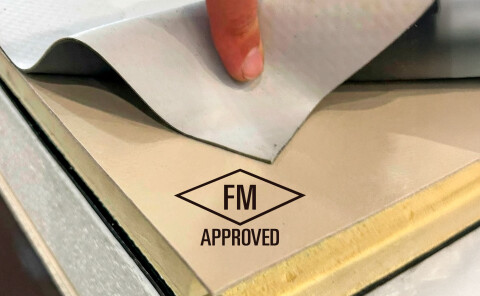
This aligns with roof systems evaluated under FM 4470 and FM 4478, where assemblies incorporating a non-combustible layer are used to improve fire performance.
Why this matters for owners and insurers
For building owners, this is about protecting assets and continuity.
For insurers, it is about controlling exposure across large portfolios.
You do not need to wait for regulation to change.
Applying higher standards at system level already makes a measurable difference.
Have you assessed the skylight zones in your PV roof system from a fire behaviour perspective? Not just for compliance, but for real performance under fire exposure.
Want to see how a non-combustible layer like BarrierSheet controls fire risk at the most vulnerable points of your roof? Get in touch with AllShield.
Our roof fire 🔥 protection solutions
Fire safety is the goal, insurability is the result
Flat roofs – especially those with solar panels – face an increasing fire risk. Even the best fire-retardant membranes offer limited protection against flying sparks or thermal ignition beneath PV panels. That’s why AllShield developed two non-combustible fire protection systems, each tailored to a specific application.

Do you have any questions for us?
We're here for you!
