
Discover our solutions for fully fire-safe 🔥 roofs
17-10-2025
Solarcomponents can fail over time, protect you business with a fire proof roof
At first sight, a solar rooftop system may seem to run flawlessly for years. But the real risk lies beneath the surface. Installation errors and material ageing can trigger fire — sometimes in the first year, sometimes after 12 or 15 years. Only a non-combustible layer in the roof build-up stops fire from spreading and keeps your property insurable.
The problem: fire risk on solar rooftops
Commercial rooftops with solar panels are growing fast across Europe. They reduce energy costs and support sustainability goals. Yet every insurer and building owner knows: every panel also adds risk.
- Connectors and DC cables can fail within the first months if poorly installed.
- Inverters and junction boxes contain electronics that degrade much faster than panels themselves.
- After about 12 years, risk rises sharply again: connectors become brittle, cable insulation hardens, and inverters reach end of life.
A system that runs trouble-free for ten years can still become a fire source in year twelve.
Why technical measures are never enough
Inspections (such as Scope 12 in the Netherlands), thermographic scans and better connectors are all useful, but none of them close the risk entirely:
- An inspection is only a snapshot in time.
- Thermography detects what is hot at that moment, not hidden defects.
- Not every weakness is visible or measurable until it fails.
In short: prevention reduces probability but never removes uncertainty. For insurers, the chance of a full roof fire remains. For owners, a small electrical fault can still grow into an uninsurable disaster.
The solution: passive protection
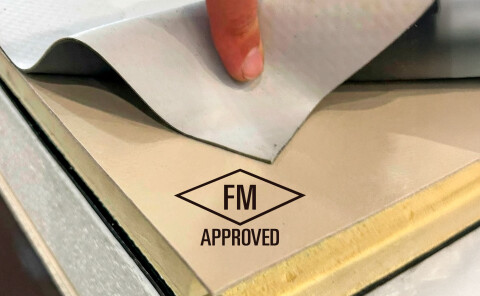
AllShield does not replace the roof. Instead, we add a non-combustible layer on top of the existing roof build-up.
- EPS, PUR, PIR or bitumen remain underneath.
- But because the fire never reaches them, it cannot spread.
- The roof behaves, in practice, as if it were non-combustible.
The effect is profound: a small incident stays a small incident. Damage is limited, the roof remains insurable, and operations continue.
Why this matters for insurers and owners
- For insurers: risks become controllable again. Catastrophic roof fires are avoided, claims are manageable.
- For building owners: solar remains a profitable investment without endangering the property or the business continuity.
- For both: peace of mind that in year 12, 15 or 20, a minor defect will never escalate into a major fire.
Outcome: certainty instead of probability
Without passive protection, fire safety remains a matter of probability: will it fail or will it not?
With AllShield, there is a hard boundary: fire cannot penetrate the roof structure. That transforms an uninsurable risk into a manageable incident.
Our roof fire 🔥 protection solutions
Fire safety is the goal, insurability is the result
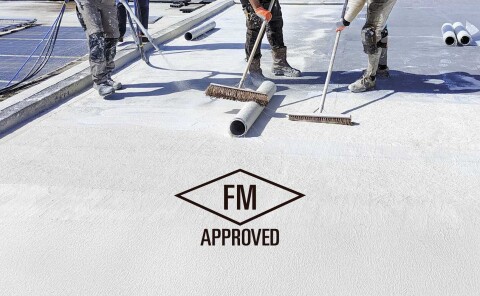
Flat roofs – especially those with solar panels – face an increasing fire risk. Even the best fire-retardant membranes offer limited protection against flying sparks or thermal ignition beneath PV panels. That’s why AllShield developed two non-combustible fire protection systems, each tailored to a specific application.
Do you have any questions for us?
We're here for you!
