
Discover our solutions for fully fire-safe 🔥 roofs
1-5-2026
ZAG and FM tests: why non-combustible roofs stop PV fires
PV fires don’t spread because of the panels. They spread because of the roof. Large-scale ZAG and FM tests confirm it. When the roof is non-combustible, fire remains local and self-extinguishes. This changes how we should design and insure PV roofs.
PV fires don’t spread because of the panels
They spread because of the roof.
This is the key insight from recent large-scale fire testing by ZAG and FM.
For years, the discussion around rooftop solar fire safety focused on panels, connectors and installation quality.
But real fire behaviour is not defined by the PV system alone.
It is defined by what sits underneath.
What the tests actually show
ZAG conducted large-scale fire tests on realistic rooftop PV assemblies, including ignition sources placed beneath the panels.
Across multiple scenarios, the behaviour was consistent:
- Fire initiates locally under the PV module.
- Flames spread within the panel footprint.
- No structural fire penetration into lower layers.
- Heat remains largely in the upper roof build-up.
- The fire decays once the local fuel source is consumed.
- Even when ignition sources were intensified beyond standard test conditions, this pattern remained unchanged.
Why this behaviour is logical
From a fire dynamics perspective, this outcome is expected.
Fire requires three elements:
- Fuel
- Oxygen
- Heat
In a PV roof system, the critical variable is fuel.
When a PV system is installed on a non-combustible base:
there is no additional fuel available beneath the system
fire cannot propagate through the roof
the fire self-extinguishes once the limited fuel is consumed
This is the same behaviour observed in ground-mounted PV systems:
On sand or gravel → no fire spread
On combustible substrates → fire spreads
The real risk is the roof, not the panel
Research and industry guidelines confirm the same principle:
PV systems can increase ignition probability
but the consequences are determined by the roof construction
In particular, insulation layers such as PIR, EPS or bitumen act as fuel in a fire scenario.
Once fire reaches these layers:
it can spread beneath the PV system
it can involve the full roof build-up
it can lead to structural fire development
Alignment with FM 4478 PV roof assemblies
FM has translated this understanding into system-level evaluation.
With FM 4478, the focus shifts from individual components to the behaviour of the full roof and PV assembly.
The principle is clear:
fire safety starts with a non-combustible base
This aligns directly with what is observed in large-scale fire testing.
What this means in practice
This insight fundamentally changes how rooftop PV risk should be approached:
ignition cannot be fully eliminated
but fire spread can be controlled
And that distinction is critical.
Because it determines whether a fire results in:
a localised incident
or
a full building loss
When the roof is non-combustible:
fire remains limited to a small area
structural layers are protected
damage is controlled and predictable
The solution: control the substrate
The technical direction is now clear:
control the roof build-up
remove combustible contribution
introduce a non-combustible layer
This prevents fire from accessing additional fuel and stops propagation through the structure.
Barriersheet: a proven approach
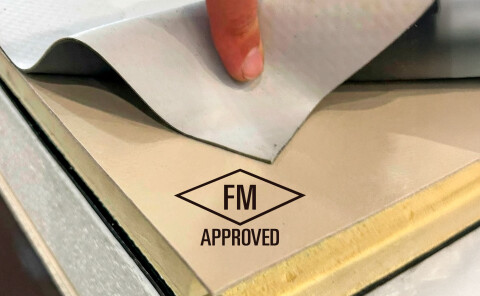
AllShield BarrierSheet is designed to implement this principle in real roof systems.
It is a non-combustible (A1) layer that:
blocks vertical flame penetration
interrupts horizontal fire spread
maintains roof integrity under PV
Tested under realistic PV fire scenarios, AllShield BarrierSheet ensures that fire behaviour remains controlled at system level.
From fire risk to insurable PV roofs
Across Europe, many rooftop PV projects have been delayed or rejected due to fire risk concerns.
At the same time, the technical pathway is now established:
non-combustible roof design
system-level fire control
alignment with insurer expectations
This turns previously high-risk roofs into viable, insurable solar projects.
Are you designing or assessing a rooftop PV system?
Then the key question is not just compliance.
It is how your roof behaves under fire.
Contact AllShield to evaluate your roof build-up and see how BarrierSheet can control fire risk and support insurability.
Our roof fire 🔥 protection solutions
Fire safety is the goal, insurability is the result
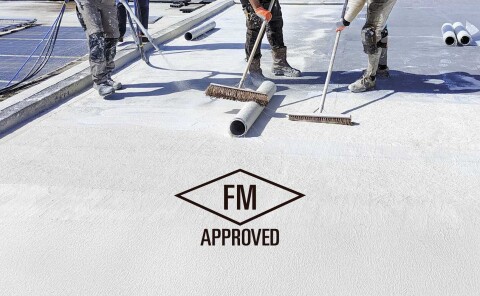
Flat roofs – especially those with solar panels – face an increasing fire risk. Even the best fire-retardant membranes offer limited protection against flying sparks or thermal ignition beneath PV panels. That’s why AllShield developed two non-combustible fire protection systems, each tailored to a specific application.
Do you have any questions for us?
We're here for you!
