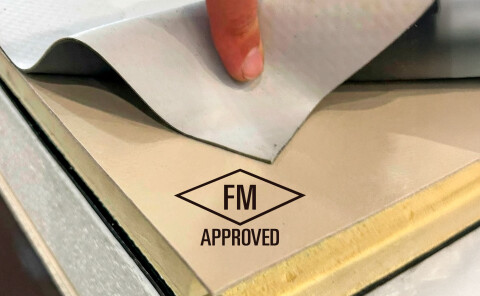

Discover our solutions for fully fire-safe 🔥 roofs
3-9-2025
Fire prevention on commercial roofs with solar panels: Why insurance is never enough
Insurance pays for buildings, not lost clients or reputation. With rooftop solar, fire risk is higher than ever. Independent ZAG tests prove AllShield BarrierSheets & Blue coatings stop flames from spreading — creating nearly unburnable roofs that protect continuity.
When a roof fire strikes, insurance can’t save your business
A roof fire can wipe out years of work in a matter of hours. Even with full insurance, studies show that 30–50% of businesses never reopen after a major fire. Insurance may pay for buildings and equipment, but it cannot bring back lost customers, restore reputation, or prevent months of downtime.
With solar panels now common on large commercial roofs, the risk is even higher: electrical faults, trapped heat beneath modules, and combustible roof materials can turn a small spark into a catastrophic blaze.
That is why prevention must come first. Recent large-scale fire tests at ZAG Slovenia, led by Prof. Grunde Jomaas, prove that AllShield BarrierSheets and Blue coatings stop rooftop fires from spreading. In practice this means a roof that is nearly unburnable — where a fire can extinguish itself before it threatens your business.
Why prevention matters more than compensation
When a fire hits a commercial facility, the damage goes far beyond what insurance covers.
Financial survival
Insurance payouts are limited to rebuilding costs and lost income for a set period. But the reality is different: rebuilding often takes longer, costs exceed limits, and many companies run out of cash before they can restart. It is no surprise that up to half of companies hit by a large fire file for bankruptcy within two years.
Downtime and lost clients
A fire shuts down operations instantly. Factories stand still, offices close, logistics stop. While you rebuild, customers turn to competitors. Some may never return, especially in industries where reliability is critical.
Reputation damage
Trust, once lost, is difficult to rebuild. A single fire can undermine years of credibility. Even after reopening, businesses often struggle to regain market share.
Hidden damage from firefighting
Water and smoke ruin what the flames did not. Stock, machinery, IT systems and archives are often destroyed not by the fire itself but by the water used to put it out. In warehouses, bluswater can cost more than the fire damage itself.
Human and legal risk
Fires endanger staff, contractors, and first responders. Injuries or fatalities bring not only personal tragedy but also legal and liability exposure.
In short: insurance writes a cheque, but it does not save your company. Prevention is the only guarantee of survival.
Why solar panels amplify the risk for fire on roofs
Large flat roofs with PV modules bring new challenges.
- Ignition sources: hotspots, arc faults, and faulty connectors can start fires on the roof.
- The oven effect: the cavity beneath solar panels traps heat and flames, raising fire temperatures far beyond normal roof conditions.
- Fuel for fire: insulation boards such as EPS or PUR, combined with bitumen membranes, act as perfect fire accelerants once ignited.
- Difficult to extinguish: panels deflect water, continue to generate electricity, and force firefighters to fight from a distance.
This combination explains why rooftop PV fires spread faster, burn hotter, and are harder to control. For businesses with valuable facilities, this is not just a technical issue, it is a fundamental risk to continuity.
Proof from independent large-scale testing
To verify how fire can be stopped at roof level, we worked with ZAG – Zavod za gradbeništvo Slovenije, Slovenia’s national building and civil engineering institute. Under the leadership of Prof. Grunde Jomaas, a leading European fire scientist, we subjected our systems to some of the harshest rooftop fire tests ever performed.
In one test, we built a 2.5 × 2.5 m roof section with EPS insulation and double bitumen layers. a highly combustible roof type. A PV panel was installed above, and a double ignition crib generating over 40 kW of fire load was lit underneath.
The result: the fire self-extinguished after 20 minutes. Flames never penetrated the BarrierSheet, and the EPS and bitumen beneath did not ignite. Without BarrierSheet, such a roof would normally burn uncontrollably.
In another test, four PV modules were installed on a steel deck with EPS and bitumen. Again, the ignition source was far more aggressive than standard lab methods. Within minutes, flames died down. The PVC membrane extinguished itself, the BarrierSheet remained intact, and fire never spread beyond the ignition zone.
These outcomes demonstrate that fire can be contained and even extinguished if the roof itself is made resistant to ignition and flame spread.
Towards an unburnable roof
With AllShield BarrierSheets beneath the membrane and Blue coatings on the surface, a roof no longer contributes fuel to a fire. Instead, the system resists ignition, prevents spread, and in many cases causes the fire to burn out on its own.
This changes the equation for building owners and insurers:
- Instead of hoping insurance covers the loss, the roof simply does not burn.
- Instead of downtime and bankruptcy, operations continue uninterrupted.
- Instead of exposing firefighters to impossible risks, the fire is over before they arrive.
Non combustible is the strongest form of protection
A commercial roof fire is not just a property loss, it is a business killer. Insurance alone cannot save companies from the chain reaction of downtime, lost customers, reputational damage, and financial collapse.
The only true solution is prevention. With proven independent tests at ZAG Slovenia, AllShield has shown that BarrierSheets and Blue coatings create roofs that resist fire and often extinguish flames before they spread.
Our roof fire 🔥 protection solutions
Fire safety is the goal, insurability is the result
Flat roofs – especially those with solar panels – face an increasing fire risk. Even the best fire-retardant membranes offer limited protection against flying sparks or thermal ignition beneath PV panels. That’s why AllShield developed two non-combustible fire protection systems, each tailored to a specific application.
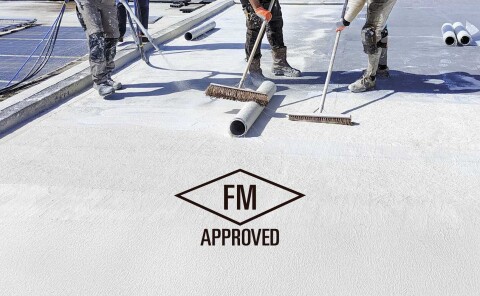
Do you have any questions for us?
We're here for you!
