
Discover our solutions for fully fire-safe 🔥 roofs
9-3-2026
How to make your roof non-combustible for PV
Installing PV on an existing roof? The first question should not be about the panels, but about the roof itself. Research shows that ignition risk may increase, but fire spread is largely determined by the roof build-up, especially the insulation. Here is a structured way to assess PV fire risk properly.
Research and large-scale fire testing show a consistent pattern: PV systems increase ignition probability. Roof build-up determines fire consequences. The membrane type plays a role, but the insulation layer is often decisive in how far and how fast fire spreads across a roof. When insulation is combustible, the consequences of a PV-related fire can be significantly greater.
That is why the first step in any PV assessment should be understanding the existing roof assembly.
Step 1 – Identify the roof build-up
Start by determining:
-
Type of roof deck (steel, concrete, timber)
-
Type of insulation (PIR, EPS, mineral wool, etc.)
-
Type of membrane (PVC, TPO, bitumen, etc.)
-
Thickness and fastening method
If the insulation is non-combustible, the risk profile is fundamentally different than with combustible insulation.
Step 2 – Is the roof non-combustible?
If the insulation layer is non-combustible and the assembly complies with recognised fire standards, the roof may already be suitable for PV from a fire-spread perspective.
If the insulation is combustible, additional evaluation is required.
This is where the decision scheme becomes critical.
Step 3 – Is full system testing available?
If the exact roof build-up has been tested at system level with PV installed, using recognised large-scale fire test methods, this data can guide the decision.
If no such system-level test exists, assumptions based on individual product classifications are not sufficient.
Fire behaviour under PV is a system interaction problem, not a single-product issue.
Step 4 – Is additional fire mitigation required?
If:
-
The insulation is combustible
-
No validated system-level test exists
-
The building has high risk exposure
-
Insurers require additional protection
Then a non-combustible separation layer between insulation and membrane should be considered.
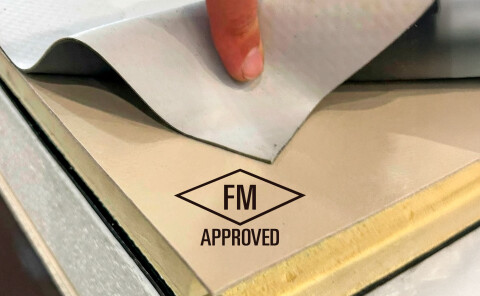
This can include a non-combustible cover board designed to limit vertical flame penetration and reduce fire spread under PV modules.
Step 5 – Consider insurance and regulatory context
In many industrial and logistics buildings, insurers increasingly require:
-
Demonstrated fire-safe roof assemblies
-
FM 4478 Approved PV systems
-
Clear separation between combustible insulation and PV ignition sources
The decision scheme is therefore not only technical, but also driven by financial and insurability considerations.
The core principle
When evaluating a roof for PV, ask two separate questions:
-
How likely is ignition?
-
If ignition occurs, how far can fire spread?
Ignition is about installation quality and electrical design. Fire spread is about roof build-up and material behaviour. A robust PV strategy addresses both.
When should you use this decision scheme?
This approach is particularly relevant for:
- Retrofitting large industrial roofs
-
Buildings with combustible insulation
-
Warehouses and logistics centres
-
Buildings with high insured value
-
Projects where insurers are involved early
If there is uncertainty about fire performance under PV, structured decision logic is better than assumptions.
Our roof fire 🔥 protection solutions
Fire safety is the goal, insurability is the result
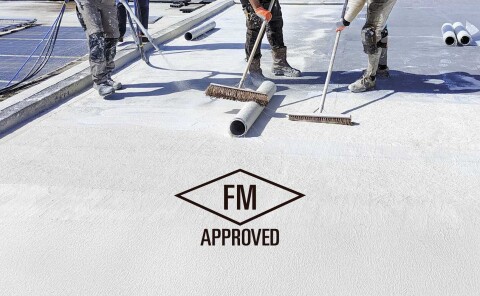
Flat roofs – especially those with solar panels – face an increasing fire risk. Even the best fire-retardant membranes offer limited protection against flying sparks or thermal ignition beneath PV panels. That’s why AllShield developed two non-combustible fire protection systems, each tailored to a specific application.
Do you have any questions for us?
We're here for you!
