
Discover our solutions for fully fire-safe 🔥 roofs
15-10-2025
The Five PV Components Most Likely to Fail – And How AllShield Keeps Rooftops Safe
Rooftop fires don’t start in the roof itself, they start in failing solar components. Connectors, cables and inverters are weak points that can ignite a blaze. AllShield ensures that even if these failures happen, your combustible roof will not catch fire.
Why this article?
Across Europe, rooftop fires with solar panels continue to make headlines. Almost every case starts the same way: a small defect in the PV system escalates because the roof beneath is combustible.
That is why AllShield collects and shares knowledge on which PV parts fail, when risks peak, and how fire spreads — so that insurers and building owners understand the real solution: stopping fire at roof level.
Five PV Components and Their Fire Risks
|
Component |
Typical failure cause |
When risk peaks |
Fire mechanism |
|
DC connectors (MC4 etc.) |
Poor installation, mismatched brands, not fully clicked |
First 0–12 months; again after 12–15 years |
Loose contact → arcing → ignition |
|
DC cabling |
Mechanical damage, UV ageing, rodent bites |
Continuous; worse after 10 years |
shorts and fire arcs |
|
Inverters |
Component fatigue (capacitors, semiconductors) |
After 8–12 years |
Overheating, internal fire spreading outside the unit |
|
Junction box (panel back) |
Poor soldering, moisture ingress, delamination |
From 5–15 years |
Local hotspot → panel ignition |
|
Modules (cells/laminate) |
Micro-cracks, glass breakage, PID effects |
Gradual, esp. after 10+ years |
Local overheating, feeding nearby combustibles |
What this means for roofs
- Fires rarely start in the roof — they start in failing PV components.
- On a roof with EPS, PIR, PUR or bitumen insulation, that tiny spark quickly becomes a full-scale blaze.
- Two danger periods are clear: the first year after installation, and again after 12–15 years when parts degrade.
How AllShield solves the problem
AllShield does not change your solar system. What we change is the roof’s response to fire.
- By adding a non-combustible layer above the combustible roof build-up, sparks or flames cannot ignite the insulation.
- Even when a connector arcs or an inverter fails, the fire cannot spread.
- The roof behaves, in practice, like a non-combustible roof.
That is why insurers accept AllShield-treated roofs as fire-safe and insurable — even with large PV arrays.
Our roof fire 🔥 protection solutions
Fire safety is the goal, insurability is the result
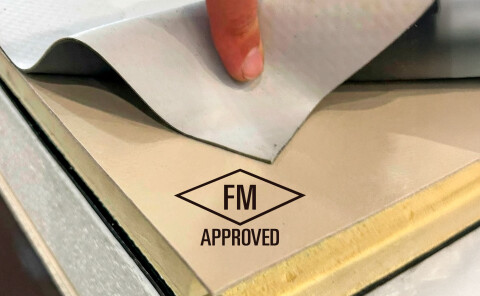
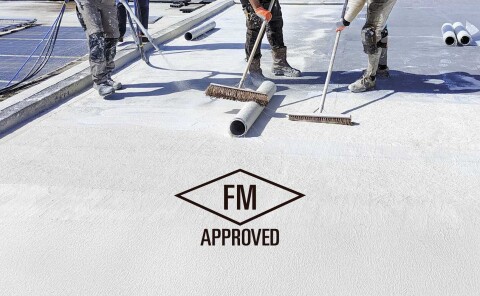
Flat roofs – especially those with solar panels – face an increasing fire risk. Even the best fire-retardant membranes offer limited protection against flying sparks or thermal ignition beneath PV panels. That’s why AllShield developed two non-combustible fire protection systems, each tailored to a specific application.
Do you have any questions for us?
We're here for you!
